Thursday, October 1, 2026

Transylvania Christmas Markets: Europe’s Best-Kept Festive Secret

1 Oct 2026

Looking for Christmas markets in Europe that don’t mean fighting through the crowds? The Transylvania Christmas markets in Romania are the answer. Medieval Saxon squares, snow-dusted cobbled streets, mulled wine and a visit to Dracula’s castle, all in one long weekend.

Ask most people to picture a European Christmas market and they’ll describe a busy German square and a long queue for a hot drink. It’s lovely, but you’ve probably seen it before. Transylvania, “the land beyond the forest”, is a very different kind of festive trip.

On our three-night Romania Christmas markets experience, you’ll visit the Christmas markets of Bucharest, Brasov and Sibiu, with two castles along the way. Here’s what to expect.

Bucharest Christmas Market: The Lights Come First

Arrive after dark and the first thing you’ll notice is the lights. The boulevards of Romania’s capital glow all the way to the old town, so your festive trip starts the moment you leave the airport.

You’ll stay in a boutique hotel in the Lipscani district. After a welcome coffee or glass of wine, head straight out to the Bucharest Christmas market.

While you’re here, treat yourself to dinner at Caru Cu Bere, the city’s oldest beer house, for a taste of traditional Romanian food.

Brasov Christmas Market: The Prettiest Tree in Transylvania

The next morning, travel into the heart of Transylvania, stopping at the magnificent Peles Castle on the way. Then comes Brasov and its spectacular Christmas tree, dressed in bright lights against the colourful old Saxon buildings of the main square. It’s arguably the prettiest of the three Christmas markets in Transylvania.

Wander the cobbled streets and the Brasov Christmas market, and warm up in one of the bohemian cafés tucked along the snowy alleys. Or join a walking tour past the Black Church and find the narrowest street in Europe. On a clear day, the cable car up Mount Tampa gives you views over the whole old town square.

Visit Bran Castle: Dracula’s Castle in Winter

On the road to Sibiu, stop at Bran Castle, better known as Dracula’s Castle. Perched high on its hilltop, with narrow corridors and hidden staircases, it’s easy to see why it became the home of the legend. The views over the surrounding countryside are superb too.

The only real fangs in these hills belong to the wildlife. The Carpathian Mountains are home to around 60% of Europe’s brown bear population, so you’re far more likely to bring home a good story than meet a vampire.

Sibiu Christmas Market: Saving the Best Until Last

Sibiu is the fairy-tale finale, and the Sibiu Christmas market is the favourite of most of our guests. The town was European Capital of Culture in 2007, and its medieval square is filled with little stalls, the smell of mulled wine and an ice rink for anyone who fancies a skate.

A local tip: keep the cold at bay with a shot of palinca, the traditional Romanian firewater. It’s strong, so take it steady, and remember the toast: “Noroc!”

Why Choose a Small Group Christmas Market Tour?

Our Transylvania Christmas Markets Experience is limited to 16 people. You get to know your guide and your fellow travellers, and you’re never lost in a crowd. As one guest, Angela, wrote on Trustpilot, it was great to be in a small group, with an excellent guide and driver, a steady pace and plenty of free time.

That balance suits a Christmas market break. You see the markets, castles and old towns with expert local guides, and still have space to wander off for a mulled wine of your own.

Your three-night trip includes:

  • All transfers and accommodation (one night each in Bucharest, Brasov and Sibiu)
  • Breakfast every morning
  • Entry to Peles Castle and Bran Castle
  • A bilingual guide
  • The Untravelled Paths experience ebooklet

Transylvania Christmas Markets FAQs
How many nights is the Transylvania Christmas markets trip?
Three nights, visiting Bucharest, Brasov and Sibiu.

When can I travel?
There are December 2026 departures on 4-7, 11-14 and 18-21 December.

Are flights included?
No. You fly into Bucharest, and we’re happy to help you find the best flights from the UK and Ireland. On the final day, book a flight home after 5pm so you reach the airport in time.

Do I need a visa for Romania?
UK, EU and US passport holders don’t need a visa for this trip.

What is the group size?
A maximum of 16 people.

Book Your Transylvania Christmas Markets Experience

If you want a Christmas market trip that feels different and a little bit magical, take a look at The Transylvania Christmas Markets Experience and choose your December dates. There are still places on all three departures.

Want to see more of the country? Browse all of our Romania tours and Transylvania trips, or try The Dracula Experience.

Written by James Chisnall

The post Transylvania Christmas Markets: Europe’s Best-Kept Festive Secret appeared first on Untravelled Paths.


from Untravelled Paths https://blog.untravelledpaths.com/blog/transylvania-christmas-markets-romania/

Top 5 Countries in Europe for Autumn Colours

1 Oct 2026

Looking for the best places to see autumn colours in Europe? Skip the summer crowds and travel when the forests turn gold, copper and crimson. Autumn is one of the most rewarding seasons to explore: the light is softer, the air is crisp, villages are busy with harvest and the trails are wonderfully quiet.

Here are our five top countries in Europe for autumn colours: Romania, Slovenia, Switzerland, Germany and Bosnia & Herzegovina. Each has something that sets it apart, from brown bears and haystack-dotted villages to golden Alpine larches and Ottoman bridges framed by blazing hillsides. For most of them, mid-October to early November is the sweet spot, although colour arrives first in the mountains and last in the valleys.

5. Bosnia & Herzegovina: uncrowded forests, waterfalls and Ottoman towns

What makes it stand out: Bosnia & Herzegovina delivers big-name drama without the big-name crowds, with golden autumn forests wrapped around Ottoman bridges, mosques and medieval towns.

Forested hills encircle Sarajevo, and in October they turn russet and gold above the red roofs of the old town. Further afield, Una National Park’s emerald rivers and waterfalls are framed by autumn woodland, and in Jajce a waterfall tumbles right into the old town. Sutjeska National Park protects Perucica, one of Europe’s last remaining primeval forests, a magnificent place to be among the changing leaves.

Because Bosnia & Herzegovina is still far less visited than the Alps, the trails are quiet and the welcome is warm. Slow down over a strong Bosnian coffee in a Sarajevo courtyard, then watch the light turn the hillsides gold. Peak colour is usually mid-October to early November, which is exactly when our Bosnia & Herzegovina Experience runs. For a shorter taste, try The Mini Bosnia Experience, which runs until October.

4. Germany: forests, vineyards and fairy-tale towns

What makes it stand out: Germany offers the widest variety of autumn scenery in a single country, from deep forests and golden vineyards to Alpine lakes and half-timbered towns, all linked by excellent trains.

In the Black Forest and the Bavarian Alps, beech, maple and larch set the hillsides alight, and Berchtesgaden’s Königssee looks spectacular ringed by colour. Along the Moselle and the Rhine, steep vineyards turn gold and red as the grape harvest wraps up, and riverside villages hold wine festivals. Look out for Federweisser, the cloudy young wine you will only find in early autumn.

Then there are the towns, from Rothenburg ob der Tauber to castle-topped villages, where cobbled streets, timber houses and falling leaves make the whole country feel like a storybook. Peak colour is usually mid-October to early November. As with Switzerland, ask us about a bespoke trip if Germany is calling.

3. Switzerland: golden larches, mountain trains and the cattle descent

What makes it stand out: Switzerland is where autumn gold meets the first snow on the peaks, and the whole spectacle is easy to reach by some of the world’s most scenic railways.

Larches are the Alps’ golden secret: unlike most conifers, they turn bright gold in autumn before dropping their needles. In valleys such as the Engadin, the larch woods glow against dark evergreens and fresh snow on the summits, usually at their best from mid to late October. Scenic trains like the Bernina Express glide right through the colour, so you can enjoy the view from a comfortable seat.

Autumn is also the season of the alpine cattle descent, when cows come down from their summer pastures in flower-decked processions, bells ringing, usually in September and October. It is a wonderfully Swiss tradition that you simply will not find in most other autumn destinations.

Switzerland is not one of our current group departures, but if it is on your wish list, get in touch and we can talk about a bespoke autumn trip.

2. Slovenia: Alpine lakes, golden larches and thermal spas

What makes it stand out: Slovenia fits Alpine peaks, glacial lakes, vineyards and thermal spas into a country so compact that you can see a remarkable amount in just a few days.

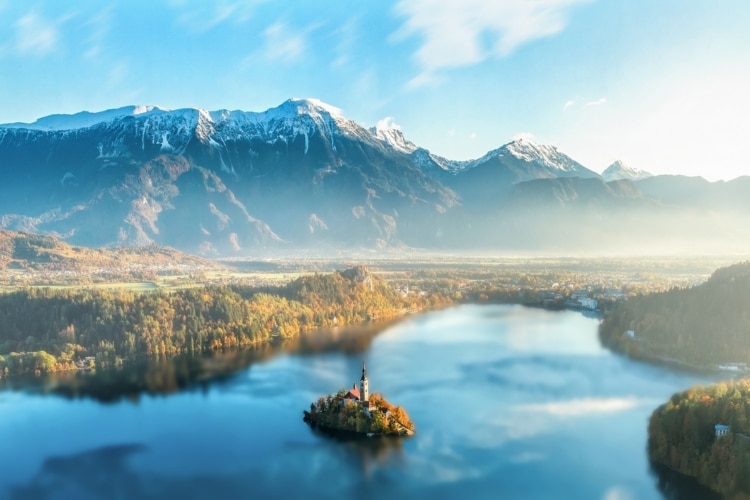
More than half of Slovenia is covered in forest, which makes it one of Europe’s greenest countries, and in autumn those woods glow amber and rust. In the Julian Alps the larches turn gold around Lake Bohinj and the Logar Valley, while Lake Bled is at its most atmospheric when morning mist drifts across the water. Distances are short, so you can hike through colourful forest in the morning and soak in a thermal spa by the afternoon.

That is exactly the rhythm of our Slovenia Nature & Spa Experience, which runs in October and November. Prefer to add some local flavours? Try The Taste of Slovenia Experience, with departures into November.

1. Romania: Carpathian forests, harvest villages and brown bears

What makes it stand out: Romania is one of the few places in Europe where autumn colour, living rural traditions and wild bears come together on a single trip.

The Carpathian Mountains hold some of Europe’s last great wild forests, and in October their beech and oak woods blaze copper and gold. Down in the valleys, Transylvania’s Saxon villages and the painted monasteries of Bucovina look their very best against the autumn hillsides. The countryside is busy with harvest too: haystacks in the fields, horse-drawn carts on the lanes and plum brandy (țuică) being distilled in village yards.

Autumn is also when brown bears are busiest, feeding up before winter, which makes it a fascinating time for wildlife watching (they are wild animals, so sightings are never guaranteed). Combine colour and culture on The Transylvania Experience, go deeper into village life on The Rural Romania Experience, or head straight for the forests on our Brown Bear Experience. All run into October.

Plan your autumn escape in Europe

Whether you dream of Carpathian beech forests, golden larches in the Alps or Bosnia’s blazing river valleys, the best autumn colours in Europe are closer than you think, and the calm, crowd-free season is the perfect time to see them.

Ready to go? Browse our small-group trips to find your perfect autumn adventure, or get in touch and we’ll design a bespoke autumn trip around you. You can also email info@untravelledpaths.com or call us on 08716629521. Let’s make this autumn your most colourful yet!

Written by James Chisnall

The post Top 5 Countries in Europe for Autumn Colours appeared first on Untravelled Paths.


from Untravelled Paths https://blog.untravelledpaths.com/blog/best-places-autumn-colours-europe/