
There are places in this world where history has not been kind. Where borders drawn by politicians have torn communities apart, where conflict has displaced families, and where neighbourhoods that once laughed together have been silenced. If you’ve been watching the news lately, from Ukraine to the Middle East and beyond, you’ll know that the weight of the world can feel very heavy indeed.
So let us tell you about a place where something quietly extraordinary is happening. A place where Russians and Ukrainians have been living side by side, in peace, for generations.
No politics. No tension. Just the river, the reeds, and the morning catch.
Welcome to Mila 23 and to the Danube Delta.
Europe’s Last Great Wilderness


Before we reach the village, let us set the scene, because the Danube Delta itself is something most travellers have never heard of and that’s precisely why it belongs on the Untravelled Paths list.
Straddling the border between Romania and Ukraine on the shores of the Black Sea, the Danube Delta is the second-largest river delta in Europe and one of the best-preserved wetlands on the planet. It has been a UNESCO World Heritage Site since 1990, and it is home to over 5,500 species of flora and fauna – including 300 species of birds, wild horses, otters, jackals, and the elusive European mink.
To travel through it is to feel genuinely far from the modern world. A labyrinth of canals, lakes, and floating reed islands stretches in every direction. Pelicans drift overhead in silent formations. Water lilies carpet the surface of still black water. The air smells clean in a way city air simply doesn’t.
This is one of Europe’s great untouched places and yet it sits just a few hours’ drive from Bucharest, or a short flight from most European capitals.
The Village at Mile 23


Deep in the heart of the Delta, accessible only by boat, lies Mila 23. The name is beautifully simple: it sits precisely 23 miles from Sulina, where the Danube meets the Black Sea. Before the Sulina Channel was straightened for navigation, this stretch of river was an all-day row, and boats travelling between Tulcea and the coast would stop here overnight. The village grew up around that pause in the journey.
Today, around 450 people call Mila 23 home. There are no roads in or out. There are no cars. A leisurely 20-minute stroll takes you from one end of the village to the other, past whitewashed houses painted in a vivid shade of ultramarine blue, a colour the locals call siniliu, said to represent the colour of the sky and closeness to God (and, more practically, to deter mosquitoes).
The houses are built from natural materials. Reed roofs catch the light. Wooden boats are moored at garden gates. Old men sit on porches watching the river. Children row themselves to school.
It is, without question, one of the most beautiful and peaceful places we have ever encountered.
The Lipovans: Refugees Who Found Their Home


The story of Mila 23 is inseparable from the story of the Lipovans — and it is a story that begins, fittingly, with people fleeing conflict and persecution.
In the early 18th century, a group of Russian Orthodox Christians refused to accept sweeping reforms being imposed on the Russian Church by Patriarch Nikon. These Old Believers, known as Starovers or Staroobradtsy, were persecuted for their faith and driven from their homeland. They fled south, following river routes into the remotest corners of the Danube Delta, where the marshes and waterways offered the one thing they desperately needed: somewhere to be left alone.

They settled. They fished. They built their blue-painted houses and maintained their ancient liturgical traditions. And in the isolation of the Delta, they thrived.
Today, the Lipovan Russians of Romania number around 50,000 people, primarily in Tulcea County. In Mila 23, they make up roughly two-thirds of the population – alongside Ukrainian neighbours, Turkish families, and a handful of Romanians. They are among the most skilled fishermen in the Delta, keepers of centuries-old recipes, and the proud custodians of a way of life that the rest of the world largely forgot to interfere with.
Side by Side


Here is the thing that stops us in our tracks when we think about Mila 23.
Beyond the village’s borders, the relationship between Russia and Ukraine is one of the defining tragedies of our time. The suffering inflicted on the Ukrainian people since 2022 has been immense — lives lost, families separated, cities reduced to rubble. It is a conflict with deep historical roots and devastating human consequences, and the pain of it echoes around the world.
And yet, in this tiny village at the end of a river, Russian Lipovans and Ukrainians have been waking up next to each other every morning for generations. They fish the same waters. They eat at the same tables. They repair each other’s boats and celebrate each other’s feasts. The Delta’s ethnic mosaic — Russians, Ukrainians, Turks, Romanians, all living in what locals and visitors alike describe as genuine harmony — has held together for centuries.

Why? Because here, life is organised around something older and simpler than politics. It is organised around the river. Around the season. Around the fish.
When your days are shaped by the tides and the catch, by the shared work of survival and the shared beauty of an extraordinary landscape, the abstractions of nationalism and ideology seem to lose their grip. There is no room for an enemy when your neighbour just helped you pull in your nets.
We are not naive enough to suggest that the answer to the world’s conflicts is simply “go fishing.” The forces that drive war and persecution are complex and deeply human. But we do believe, and Mila 23 is evidence, that when people live in genuine proximity, sharing the rhythms of daily life, something remarkable and natural tends to emerge. Kinship. Respect. Peace.
A Day in the Delta


If you’re beginning to feel the pull of this place, let us paint the picture a little more vividly.
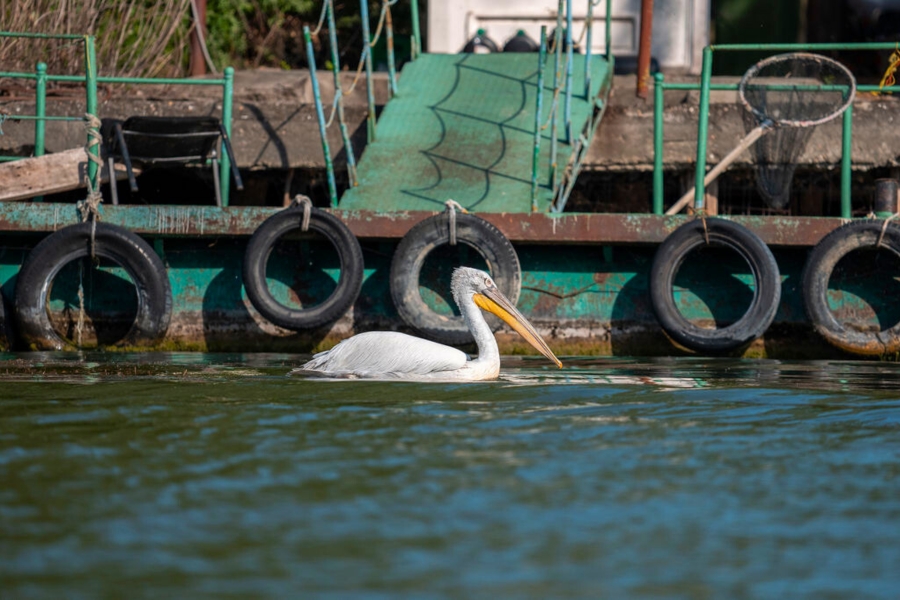
You arrive by boat from Tulcea, the gateway city to the Delta. The journey itself is part of the experience — gliding through channels lined with towering reeds, past floating islands and mirror-still lakes. Keep your eyes on the sky: you may spot Dalmatian pelicans (the largest pelican in the world), white-tailed eagles, pygmy cormorants, or the rare red-breasted goose.
In Mila 23, you step off the boat onto a wooden pier in the centre of the village. From here you wander, slowly, because there is no reason to hurry. You visit the Canoe Museum, a beautiful open-air tribute to the village’s extraordinary sporting heritage. Mila 23 has produced more Olympic medallists in kayak and canoe than almost anywhere on earth, most famously Ivan Patzaichin, a four-time Olympic gold medallist who grew up here among the fishing boats and is still revered as a living legend.
You eat. Oh, you eat. The Lipovan fish-based cuisine is a revelation, fresh carp, pike, and perch cooked with generations of knowledge behind every recipe. Try the fisherman’s borscht: a rich broth of ten or fifteen small fish, strained and then finished with chunks of sturgeon or carp, spiced simply and served steaming. Try the storceag, a sturgeon soup enriched with egg yolk and sour cream that will haunt you pleasantly for weeks.
In the evening, the Delta does something astonishing. It goes quiet. Truly quiet, in a way that you realise you have not experienced in a very long time. And then the frogs begin their concert, and the stars come out, and the river turns silver, and you understand exactly why people who came here as refugees decided never to leave.
Come. Breathe. Remember What Matters.

We know the world feels heavy right now. Many of us are carrying grief for places we love, for people we’ll never meet, for a state of affairs that seems impossibly tangled. If you are one of those people, and most of us are, then perhaps what you need is not a distraction, but a reminder.
A reminder that human beings, left to their own devices and the rhythms of nature, are remarkably good at getting along. That simple lives, lived close to the earth and the water, have a way of dissolving the divisions we’ve been taught to believe are permanent.
Mila 23 won’t solve anything. But it might restore something.
If you feel called to a place where the news cannot reach you, where the river sets the agenda, and where Russians and Ukrainians sit at the same table sharing the same soup, then the Danube Delta is waiting.
And honestly? It’s one of the most beautiful places on earth to remember what peace actually feels like.
Have you visited the Danube Delta or Mila 23? We’d love to hear your story in the comments below. And if you’re dreaming of making the journey, get in touch, we’re always happy to help you plan the trip of a lifetime.
Share this post if it moved you. Some stories deserve to travel further.
Written by James Chisnall
The post Where Russians and Ukrainians Live in Perfect Harmony and What the World Could Learn From Them appeared first on Untravelled Paths.
from Untravelled Paths https://blog.untravelledpaths.com/blog/russians-ukrainians-harmony-danube-delta/

No comments:
Post a Comment