
We’ve Just Arrived in the Americas and Guatemala Is Everything We Hoped For.
Something rather significant has been happening at Untravelled Paths. After years of bringing you extraordinary adventures across Africa and Europe, we’ve officially expanded into the Americas. And while Costa Rica was our first foray into this breathtaking part of the world, Guatemala has arrived to offer something altogether different, a destination that gets deep under your skin, not just through its landscapes, but through its people, its history, and its extraordinary, living, breathing Maya culture.
Right now, Central and South America represent one of the most compelling regions on earth for travellers who want something genuinely meaningful. The ancient civilisations here are not relics, they are living traditions, spoken languages, woven textiles, and sacred ceremonies still observed today. The landscapes are dramatic to the point of improbability, volcanoes rising from highland lakes, jungle canopies concealing cities older than Rome, cobblestone streets laid by the Spanish in the 16th century and still walked by Maya women in traditional dress.
Why now? Because Guatemala is at a wonderful sweet spot for travel. The infrastructure for thoughtful, responsible tourism has never been better. Direct flights connect easily with the UK and Europe via a single stop. Yet the country retains an authenticity that is becoming increasingly rare, a place where indigenous culture hasn’t been flattened into performance for visitors, but remains genuinely, proudly, daily life.
Our new Guatemala adventure visits four extraordinary destinations: Antigua, Lake Atitlán, Chichicastenango, and Flores, each one offering a different dimension of this remarkable country. Together, they paint a portrait of a civilisation that is simultaneously ancient and entirely alive.
Antigua: Where Colonial Grandeur Meets Mountain Life
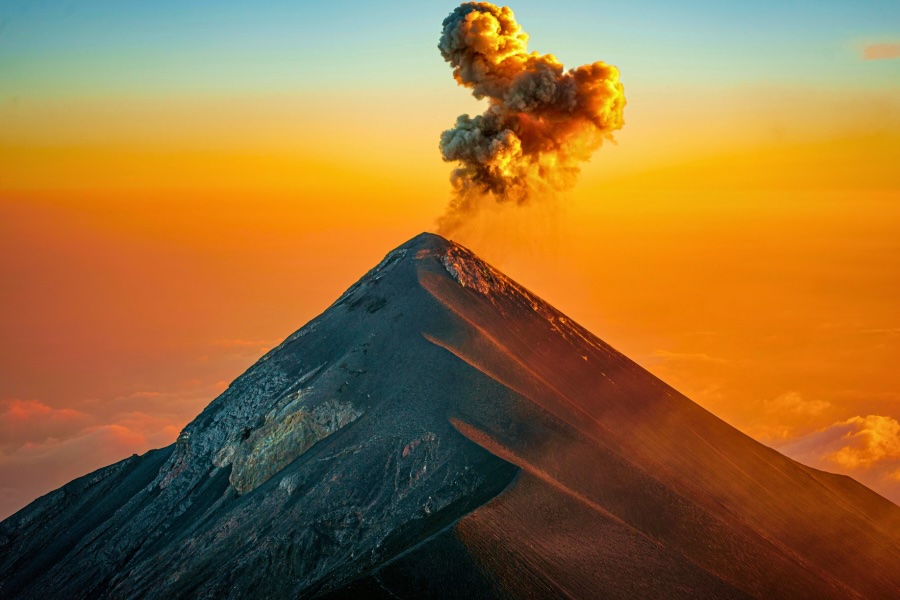
The first thing you notice about Antigua is the volcanoes. Three of them ring the city: Agua, Fuego, and Acatenango, their peaks rising above the rooftops in various states of drama. Fuego, as its name suggests (“fire”), puffs smoke intermittently throughout the day, a constant reminder that you are somewhere the earth itself is still active.
Antigua is a UNESCO World Heritage Site, and its colonial architecture is among the best preserved in all of Latin America. Founded in 1543 as the third Spanish colonial capital of Central America, it was largely destroyed by a catastrophic earthquake in 1773, after which the Spanish authorities ordered the capital moved to what is now Guatemala City. Many residents refused to leave. The ruins of their churches and convents remained. And today, those earthquake-damaged structures and their crumbling baroque facades draped in bougainvillea, their roofless naves open to the sky and are among the most hauntingly beautiful sights in the Americas.
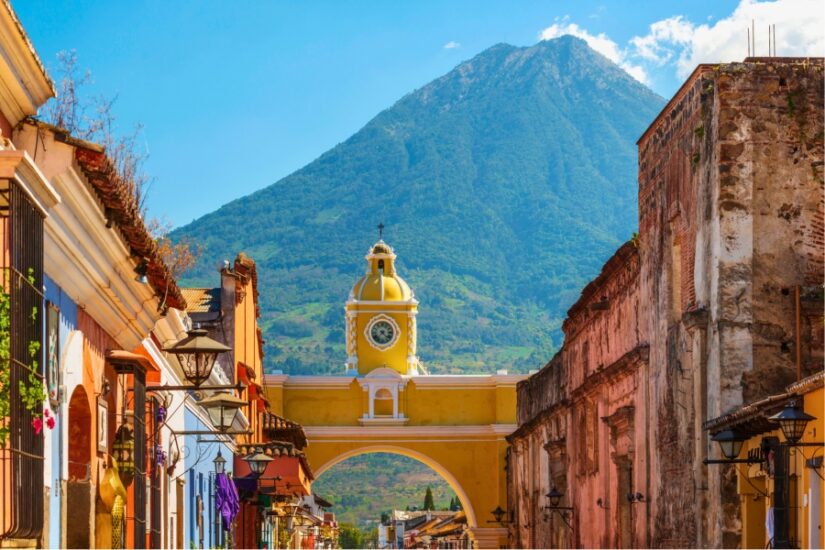
Walking Antigua is a joy that requires no particular agenda. The cobblestone streets are lined with pastel-painted colonial mansions whose doorways open onto hidden courtyards with bougainvillea-covered fountains. The Arch of Santa Catalina, an iconic 17th-century archway spanning the street with a clock tower above, the perfect cone of Volcán de Agua framed in the background, is one of those views that stops you mid-stride and makes you reach for your camera. The Parque Central, where the Cathedral of Santiago stands in dignified ruin beside the restored Palace of the Captains General, is the beating heart of the city, and the best place to simply sit, watch the world go by, and absorb the extraordinary atmosphere.
Beyond the architecture, Antigua offers some of the finest cultural experiences in Central America. A cooking class with a local family, visiting the market first to select the chillies, corn, and spices, then learning to prepare traditional dishes like pepián (a rich, pumpkin-seed-based stew) and tamales and is one of the most intimate ways to understand a place. The city’s chocolate scene is extraordinary: Guatemala’s cacao heritage goes back to the Maya, and workshops in Antigua let you trace the whole journey from bean to bar. And the coffee is, genuinely, among the best in the world, Antigua’s volcanic soil and high altitude produce beans of exceptional quality, and a coffee tour through the surrounding farms offers both spectacular scenery and a lesson in one of Guatemala’s defining industries.
For the adventurous, Acatenango volcano offers one of the great hikes in Central America, a demanding ascent that rewards with close-up views of Fuego erupting across the valley, ash and fire glowing against the night sky from the summit camp.
Lake Atitlán: The Most Beautiful Lake in the World
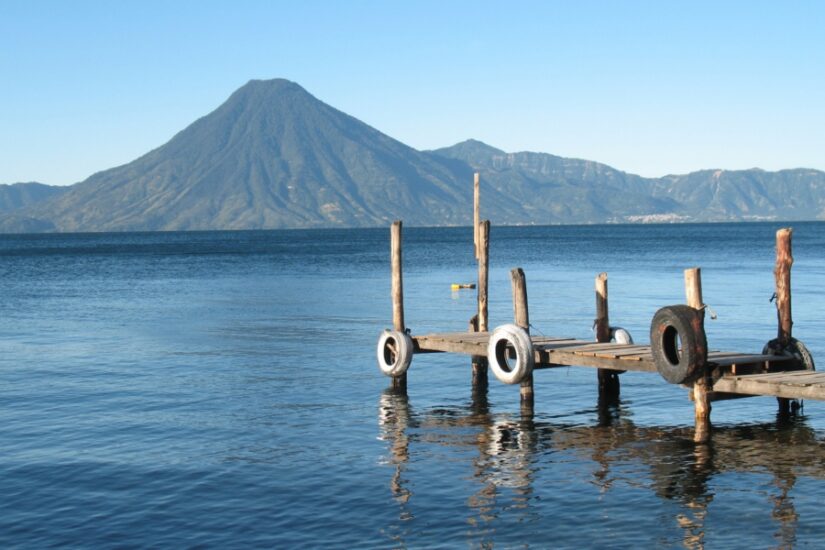
Aldous Huxley, after visiting in 1934, famously declared Lake Atitlán “too much of a good thing.” We understand exactly what he meant.
No photograph adequately prepares you for it. The lake formed in the caldera of an ancient super-volcano some 80,000 years ago, stretches 18 kilometres across and plunges to a depth of 340 metres, making it the deepest lake in Central America. Three enormous volcanoes: Atitlán, Tolimán, and San Pedro, line its southern shore, their reflections shimmering in the impossibly blue water. And around its edges, twelve different Maya villages each maintain their own traditions, their own dialect of the K’iche’ or Tz’utujil language, their own distinctive patterns of woven dress.
There are no roads circling the lake. To move between villages, you travel by lancha, the wooden motorboats that dart across the water throughout the day, connecting communities that have existed in this astonishing setting for centuries. Each crossing is a miniature spectacle: the volcanoes shifting in perspective, the light changing on the water, the villages appearing around headlands like illustrations in a story.
The villages are the real revelation. San Juan La Laguna is a place of quiet creative pride, its streets lined with murals painted by local artists, its weaving cooperatives run by Tz’utujil Maya women who use traditional backstrap looms and natural plant-based dyes to create textiles of extraordinary beauty. Watching a weaver work the rhythm of her loom, the precision of the patterns, the colours she selects from plants grown in her own garden, is a genuinely moving experience. You come to understand that these textiles are not merely products. They are visual language, each pattern carrying meaning, each colour tied to a village, a lineage, a story.
Santiago Atitlán is the largest and perhaps most culturally significant of the lake villages. It is the seat of the Tz’utujil Maya and the home of Maximón, a unique deity formed from the fusion of ancient Maya spirituality, Catholic saints, and colonial-era mythology, who lives in a different house each year under the stewardship of a local brotherhood. Visiting Maximón following the instructions of a local guide to find whichever house he currently occupies, involves entering a room thick with copal incense, candles, and offerings of rum and cigarettes, while local shamans conduct private rituals alongside curious visitors. It is one of the most distinctive cultural encounters in all of Central America: a living demonstration of how indigenous Guatemalan spirituality absorbed and subverted five centuries of Spanish Catholicism rather than being destroyed by it.
The light at Lake Atitlán in the late afternoon, when the volcanoes turn purple and the water goes still and the cooking fires in the villages send wisps of smoke into the golden air, is something you carry home with you.
Chichicastenango: The Market at the Heart of the Maya World
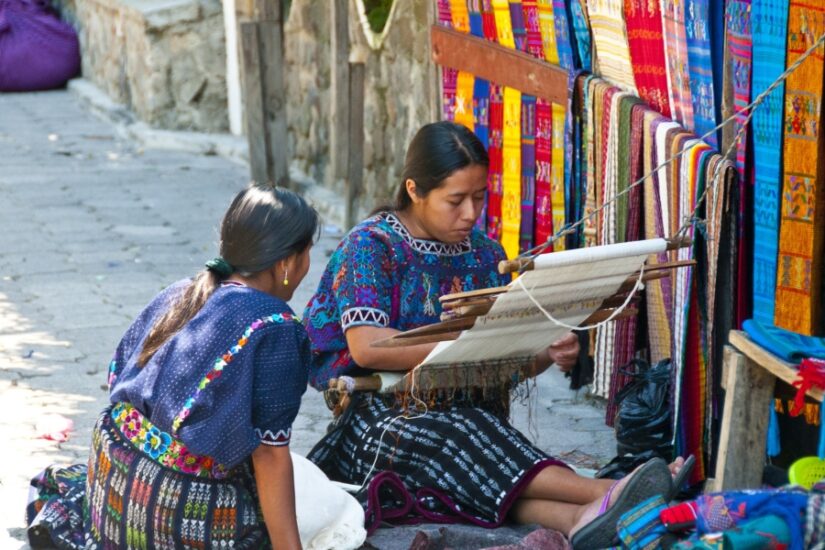
Every Thursday and Sunday, something extraordinary happens in the mountain town of Chichicastenango.
The streets explode.
Vendors arrive before dawn, many of them having hiked for hours through the surrounding highlands and by the time the mist clears from the valley, the Chichicastenango market is in full, extraordinary, overwhelming life. It is the largest indigenous market in Central America, and one of the most authentic in the entire world. Around 99% of the town’s population of 72,000 are K’iche’ Maya, and the market has been a trading hub for this community since long before the Spanish arrived in the 16th century. It continues, unchanged in its essential nature, today.
What you encounter is not a market designed for tourists. It is a market designed for Maya people, who happen to tolerate tourists with considerable good humour. The women who travel here from surrounding villages wear the traditional embroidered blouses and woven skirts of their particular community colours and patterns that vary by village, so that an experienced eye can identify where someone is from at a glance. They spread their goods on the ground or on makeshift stalls: handwoven textiles, carved wooden masks, pottery, flowers, incense, traditional healing remedies, corn, beans, chillies, and fruits. The smells copal resin, frying tortillas, woodsmoke, tropical flowers and layer upon each other in a way that is somehow both overwhelming and entirely intoxicating.
At the centre of the market stands the Church of Santo Tomás, and here Chichicastenango reveals its deepest mystery. Built by the Spanish in the 17th century atop a Maya pyramid, the church was constructed with local labour and those labourers, it is said, quietly incorporated their own religious symbolism into the building. The result is one of the most extraordinary examples of cultural syncretism in the Americas. Today, on market days, the steps of Santo Tomás are occupied simultaneously by vendors selling flowers and candles, by K’iche’ Maya shamans burning copal incense and performing traditional ceremonies, and by Catholic priests conducting masses inside. The smoke rises into the morning air from all sides. It is as if the building itself is a living argument between two spiritual systems that have, over five centuries, learned to coexist.
The Popol Vuh, the sacred Maya text that narrates the story of creation, the great literary achievement of indigenous America, one of the few surviving documents to have escaped the systematic destruction of Maya culture by Spanish missionaries and was discovered here, at Santo Tomás Church. Standing on those steps, watching the copal smoke curl upward and listening to the K’iche’ language spoken all around you, it is impossible not to feel the weight of that history.
Away from the church, the market is simply a delight: chaotic, colourful, alive, generous. Bargaining is expected and warmly conducted. The food stalls serve fresh tortillas, tamales wrapped in banana leaves, fried plantains, and steaming bowls of local specialities that you’ll struggle to identify but will almost certainly enjoy. And the Chichicastenango cemetery, considered one of the most vibrantly coloured in the world, its above-ground tombs painted in whites, turquoises, and yellows that carry specific Maya spiritual significance, an extraordinary, quietly moving place that most visitors pass without realising its importance.
Flores & Tikal: Where the Jungle Holds Ancient Secrets
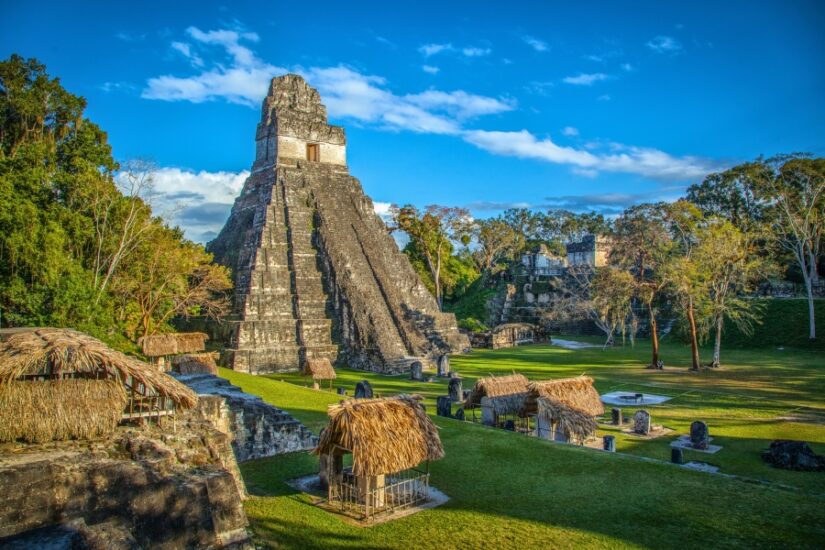
The journey north to Flores feels like crossing into a different world. The landscape flattens, the air grows heavier and hotter, and the dense lowland jungle of the Petén closes in on either side of the road. By the time you arrive at the causeway connecting Flores to the mainland, you have the distinct sense of having arrived somewhere at the edge of the known.
Flores is a delight. A tiny island town, small enough to walk around in under 20 minutes, sits on Lake Petén Itzá. Its buildings are painted in pastel yellows, blues, and pinks that glow in the late afternoon sun. Narrow streets wind between restaurants, small boutique hotels, and local bars where you can sit with a cold Gallo beer and watch the lake change colour as evening falls. It is one of those towns that is easy to love immediately and genuinely hard to leave.
But Flores is really a base for something that has no equal in all of Central America.
Tikal.
Ninety minutes north through the jungle, at the heart of the Maya Biosphere Reserve, one of the largest protected tropical forests north of the Amazon, sees ruins of one of the greatest cities in the ancient world emerge from the trees. Tikal was founded around 400 BC and grew over the following centuries into a metropolis of perhaps 100,000 people, a centre of political power, astronomical knowledge, artistic achievement, and military might. At its peak in the 8th century AD, it dominated a vast territory and traded with civilisations as distant as Teotihuacán in central Mexico. Then, like so many Maya cities, it was gradually abandoned and reclaimed by the jungle over the following centuries until, in the 20th century, archaeologists began to cut back the undergrowth and reveal what lay beneath.
What they found was extraordinary. And what visitors find today, arriving at dawn as the jungle wakes around them, howler monkeys calling from the canopy, toucans moving through the mist is an experience that defies easy description.
The temples of Tikal rise above the jungle canopy, their stepped pyramids reaching heights of 70 metres. Temple IV, the tallest pre-Columbian structure in the Americas, offers from its summit the view that George Lucas used as a stand-in for an alien planet in the original Star Wars, a sea of green punctuated by grey stone peaks disappearing into morning mist. It is a view that makes you feel very small, and very fortunate.
The sunrise tour departing Flores at 3am, arriving in the dark jungle to the sound of unseen creatures, waiting on the summit of Temple IV as the sky slowly lightens and the howler monkeys begin their tremendous dawn chorus, is among the most genuinely extraordinary experiences available to a traveller in the whole of the Americas. We would go so far as to say it is one of the finest experiences on any of our trips anywhere in the world.
Around the great plazas, the ceiba trees, sacred to the Maya as the tree of life and stand sentinel over stone stelae carved with hieroglyphs that narrate the deeds of kings long dead. Spider monkeys swing between branches overhead. Coatis root in the undergrowth. The air smells of earth and vegetation and something ancient. And you walk these paths understanding that beneath almost every tree-covered mound around you lies an unexcavated structure that Tikal National Park has only barely scratched the surface of what lies beneath the jungle floor.
The Perfect Combination: Guatemala with Belize or Costa Rica
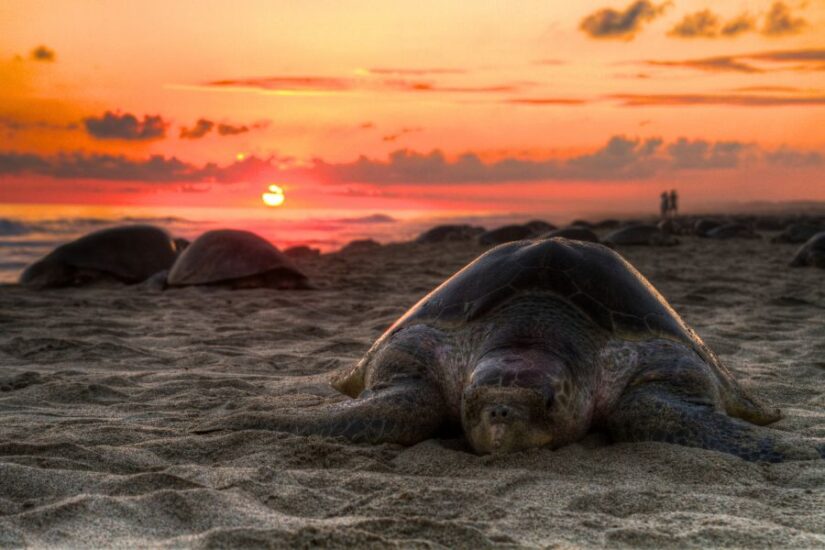
Guatemala is extraordinary on its own. But it also sits at the heart of one of the richest travel regions on earth and combining it with a neighbouring destination creates a trip of truly exceptional breadth and variety.
Flores and Belize make a particularly natural pairing. From Flores, the border with Belize is only a few hours away, opening up the Belize Barrier Reef, the second-largest coral reef system in the world and the extraordinary Mayan ruins of Caracol and Lamanai, and some of the finest jungle lodges in Central America. Ancient history and world-class snorkelling, back to back.
Guatemala and Costa Rica offer a different kind of combination, one pairing deep cultural immersion with extraordinary wildlife. The contrasts between the two countries are part of what makes the combination so compelling: the highland Maya world of Guatemala, with its markets and volcanoes and colonial cities, followed by the extraordinary biodiversity of Costa Rica’s rainforests, cloud forests, and Pacific coast.
We can organise both combinations for you, seamlessly and with the same care and attention we bring to every Untravelled Paths experience. A combined itinerary can be as short as ten days or as long as three weeks and every element will be chosen with the same passion for authenticity and quality that you’d expect from us.
Ready to Experience Guatemala for Yourself?
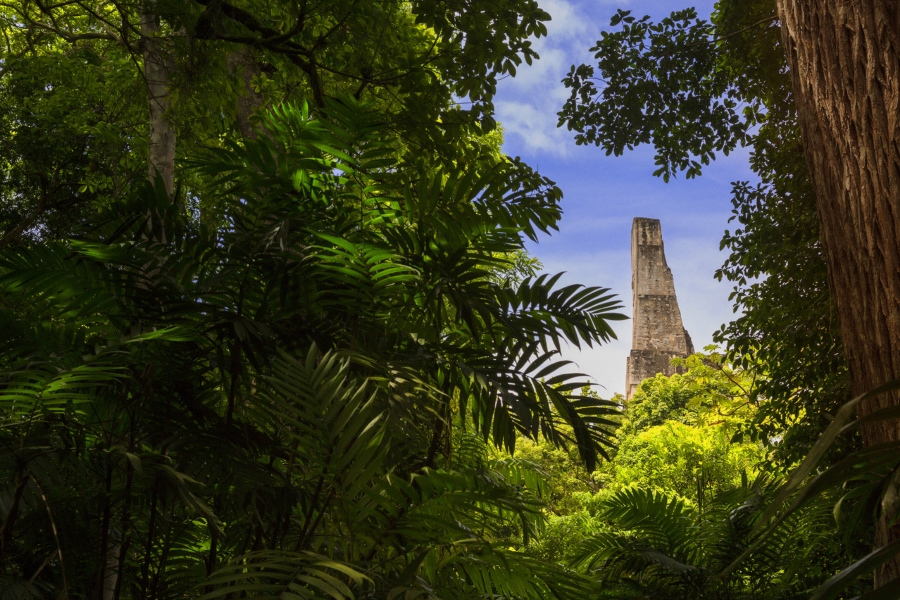
This adventure has quickly become one of our very favourites in the Untravelled Paths portfolio. The combination of extraordinary cultural depth, dramatic natural beauty, and genuine, warm Guatemalan hospitality makes it a trip that our guests talk about long after they’ve come home.
If Guatemala has been on your list and it absolutely should be, we’d love to help you plan the trip. Get in touch with us today and we’ll start putting something together that’s built around you. And if you’d like a proper conversation about the itinerary and what to expect, we’d be delighted to schedule a Zoom call with one of our team and just say the word and we’ll find a time that suits.
Guatemala is waiting, and it is magnificent.
Written by James Chisnall
The post The Soul of the Maya: Experiencing Guatemala’s Most Authentic Culture on Our Brand-New Adventure appeared first on Untravelled Paths.
from Untravelled Paths https://blog.untravelledpaths.com/blog/guatemala-cultural-travel-adventure-untravelled-paths/

No comments:
Post a Comment